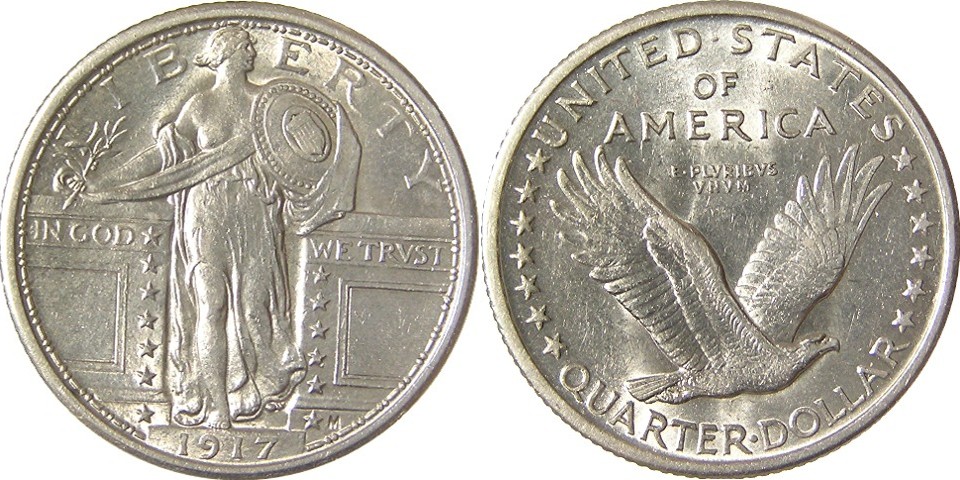
A design changed for detail and durability
Hermon A. MacNeil’s design replaced the Barber quarter in 1916. Liberty stands in a gateway with a shield and olive branch, combining protective and peaceful imagery. The flying eagle reverse sets it apart from the later Washington quarter’s heraldic eagle.
During 1917, Liberty’s clothing and the reverse arrangement changed. The later design is known as Type 2. A further practical change came in 1925, when the date was recessed to help it survive circulation. That history explains why an otherwise recognizable coin can have a date worn almost smooth.
These changes are useful identification clues, not reasons to assume every early example is rare. The series should also be distinguished from the much larger Walking Liberty half dollar: read QUARTER DOLLAR on the reverse. For the later silver quarter, see 1964 Washington quarter value.
Type 1, Type 2 and the recessed date
Design differences to inspect| Version | Visible identification |
|---|
| Type 1: 1916 and part of 1917 | Liberty’s exposed breast; no three stars directly below the eagle. |
|---|
| Type 2: later 1917–1930 | Chain-mail covering; three stars below the eagle. |
|---|
| 1925–1930 date modification | Date recessed into the pedestal, improving resistance to wear. |
|---|
| No mint mark / D / S | Philadelphia / Denver / San Francisco; D or S is on the obverse near the date, to the viewer’s left. |
|---|
Both major types exist with a 1917 date. Read the date, inspect the clothing and then check the stars below the eagle. Do not identify the type solely from a seller’s title. On a worn coin, compare several surviving details instead of forcing a conclusion from one faint line.
A missing mint mark is normal for Philadelphia. The 1925 modification is often discussed separately in collecting guides, but it does not replace the underlying Type 2 design. Keep the classification convention clear when comparing listings.
Silver content and key dates
Series facts| Feature | Detail |
|---|
| Years | 1916–1930, excluding 1922. |
|---|
| Denomination | Quarter dollar: 25 cents. |
|---|
| Metal | 90% silver, 10% copper. |
|---|
| Silver reference | About 0.18084 troy ounce at the original standard weight; wear reduces actual metal. |
|---|
| 1916 | First-year issue; reported mintage 52,000. |
|---|
| 1918/7-S | Recognized overdate requiring a specific attribution. |
|---|
Other dates can carry substantial premiums depending on grade and strike, so the absence of these two headline varieties does not complete an appraisal. Use a date-and-mint listing for the exact coin rather than a generic “Standing Liberty silver quarter” price.
Do not use chemicals to recover a worn date. An apparent final digit, altered date or added mint mark should be examined carefully before purchase. Keep suspected keys uncleaned and consult the appraisal guide.
How to compare silver value and collector value
Silver reference = 0.18084 × silver price per troy ounce. At a hypothetical $50 per ounce, the full-weight metal calculation is about $9.04. This is an illustration, not a live quote, a dealer offer or a guaranteed resale price. A worn coin contains less metal; a collectible example can be worth more than its silver.
Value checkpoints · reviewed October 16, 2026| Coin / version | Condition | Value basis | What supports a premium | Comparison limit |
|---|
| Common date | Heavily worn | Silver content plus any collector premium | Readable date and acceptable surfaces | Metal calculation is not a dealer bid. |
|---|
| Common date | Clearly detailed circulated | Same date, mint and grade sales | Remaining design detail | Cleaning can reduce appeal. |
|---|
| Any date | Mint State / Full Head | Same grade and designation sales | Original luster and head detail | Full Head is not interchangeable with overall grade. |
|---|
| 1916 or attributed overdate | Any condition | Authenticated issue-specific comparison | Rarity and preservation | Do not extrapolate from an unverified date. |
|---|
This guide does not assert a current grade-by-grade market range. For a useful comparison, record the date, mint, type, grade, Full Head status and any cleaning or damage. Then compare actual sold coins with those same attributes. Read the grading guide before comparing a worn example with a high Mint State auction result.
The series has no regular Proof issues. A shiny or reflective surface is therefore not enough to label a coin a Proof. Surface alteration and lighting can both create misleading appearances.


 App Store